• First published in 2004 as Bartholomew’s Notes on Religion (BNOR).

    Previously at:
    blogs.salon.com/0003494
    barthsnotes.wordpress.com

    Email me
    (Non-commercial only)

    Twitter: @Barthsnotes

  • Recent comments

  • Archives

Stuck with the Synagogues

The BBC has been covering Israel’s decision to leave behind a number of synagogues in Gaza. This has been in the offing since a couple of weeks ago – YNet News reported at the end of August:

Chief Rabbis Shlomo Amar and Yona Metzger were invited to attend Sunday’s government session called to discuss the razing of synagogues in the Gaza Strip and northern West Bank.

The rabbis have raised a last-minute demand, calling on the government to refrain from demolishing the synagogues and ask the Palestinian Authority to safeguard them under international monitoring.

…The decision to invite the chief rabbis to attend Sunday’s government session followed an opinion offered by Rabbi Amar, and also backed by leading rabbis Yosef Shalom Elyashiv and Ovadia Yosef, which called to leave the Gaza synagogues intact. Razing the synagogues would serve as a precedent for demolishing synagogues in abandoned Jewish communities overseas, the rabbis said.

We’re also told that Chief Ashkenazi Rabbi Yona Metzger had favoured demolition, as the buildings were no longer sacred, but had changed his mind following “scathing criticism”. WorldNetDaily also noted religious objections:

Rabbi Shear-Yashuv Cohen, former chief rabbi of Haifa and a member of the chief rabbinate, told WND, “According to Jewish law, synagogues cannot be destroyed unless new ones are already built, and even then, the issues are complicated. Here, the former Gush Katif residents don’t have homes yet to live in, new synagogues have not been built, so there isn’t even a question.”

Cohen is referring to Baba Bathra 3b in the Talmud, which states that

Some honor is to be paid even to the ruins of a synagogue or house of study. It is not proper to demolish a synagogue and then to build a new one either on the same spot or elsewhere; but the new one should be built first (B. B. 3b), unless the walls of the old one show signs of falling.

But does this apply to a synagogue in an area that has been abandoned? It looks to be like a practical instruction concerning how a synagogue should function in a community – obviously if you demolish before building a new one, there will be no place to worship or keep the holy objects in the interim. But I’m no Talmudic scholar…

Meanwhile, some Israeli politicians have taken this position even further:

Foreign Minister Silvan Shalom explained his decision to vote against demolishing the structures…”Jews do not destroy synagogues,” said Shalom.

Mark Elf at Jews Sans Frontieres finds that argument rather odd:

This is very strange because, not that long ago, Stanley Kalms wrote a report on the United Hebrew Congregations of the British Commonwealth and how it should function in future. He argued for the disposal of various shuls (synagogues) on the grounds that it was uneconomic to keep them. I remember one in Earlham Grove in London E7. My nan used to go there. Even I went there sometimes. Well it’s not there now.

Shalom added:

“I hope the Palestinian Authority will come to their senses and not allow barbarism and vandalism to rule over the synagogues. If this does happen, the world will see what we’re dealing with.”

Or in other words, as Haaretz puts it in a critical article:

If the synagogues are doomed to be destroyed, let the Palestinians do it rather than the Israelis, to make them look bad in the eyes of the world.

The fear (or hope?) is that there will be a repeat of the unattractive scenes that followed Israeli withdrawal from Nablus in 2000, when Joseph’s Tomb was attacked and Jewish objects destroyed. (WND absurdly called this “one of the most extreme holy site desecrations in history”, putting both Antiochus IV and the Fourth Crusade into a rather odd perspective.)

The same article goes on to note that:

Out of some 140 village mosques that were abandoned due to the war in 1948, some 100 were totally torn down. The rest, about 40, are in advanced stages of collapse and neglect, or are used by the Jewish residents for other purposes.

…Several mosques serve as housing, and others are used for commercial and cultural purposes. The mosque of an abandoned village on the Iron Valley serves a kibbutz carpentry. A mosque in an artists’ community in the Carmel serves partly as a restaurant and bar. Other mosques serve as museums and galleries. The large synagogue in a township near Rehovot is located inside the abandoned village’s mosque, whose minaret was destroyed and the symbolic half crescent atop its dome has been replaced by a menorah.

One suggestion made by a Palestinian spokesman I just heard on the World Service was having the synagogues shipped out to the USA. Another possibility has also been raised. Back to YNet News:

“There’s obviously a danger that should the synagogues remain they will be desecrated, and may even be turned into mosques,” sources in Jerusalem said.

Turned into mosques? Let’s see now…
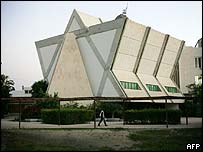
gaza-synagogue

Israeli Religious Right Blames Gaza for Katrina

Aaron Klein, WND‘s Jerusalem correspondent and frequent puffer of the Israeli far-right, rounds up some religious opinions about Hurricane Katrina. Not many surprises:

“Katrina is a consequence of the destruction of [Gaza’s] Gush Katif [slate of Jewish communities] with America’s urging and encouragement,” Rabbi Avraham Shmuel Lewin, executive director of the Rabbinic Congress for Peace, told WND.

…Rabbi Joseph Garlitzky, head of the international Chabad Lubavitch movement’s Tel Aviv synagogue, recounted for WND a pulpit speech he gave this past Sabbath: “…And here there are many obvious connections between the storm and the Gaza evacuation, which came right on top of each other. No one has permission to take away one inch of the land of Israel from the Jewish people.”

Garlitzky goes on to recount the mystical similarities (the exception being that moving Israelis into Israel proper is wicked, while killing thousands of Americans is just God’s righteousness), such as:

Close to 10,000 Jews were expelled from their homes in the Gaza Strip and parts of northern Samaria. Katrina’s death toll is now expected to reach at least 10,000.

(Further alleged similarities have also appeared in an article for Israel Insider by Israel National Radio host Tamar Yonah. These include “‘Katrina’ sounds very similar to ‘Katif'”)

In fact, both Garlitzky (vars. Yosef Gerlitzky, Yosef Gololutzsky) and Lewin are part of the so-called Rabbinic Congress for Peace, which in Hebrew goes by the name of Pikuach Nefesh, refering to “saving a life”. It is opposed to withdrawal from any land captured by Israel in 1967; in December its deputy chairman, settler rabbi David Drukman, told the UPI that Palestinians living in such areas “should recognize their place”. Lewin, who also works as a journalist, claims there are 1,200 members. Garlitzky, Lewin, and Drukman are all part of the Chabad (“Lubavitcher”) movement, which saw the Asian tsunami as evidence for the coming of the Messiah.

However, the RCP is not just for Chabad members; it also includes Rabbi Ya’acov Yosef, the son of Shas’s spiritual leader and former Shepardic chief rabbi Ovadia Yosef. Ya’acov and Ovadia have their differences, although a belief in God killing Americans in vengeance for Gaza is not one of them. Ynet News reports:

Hurricane Katrina is a punishment meted out by God as a result of U.S. President George W. Bush’s support for the Gaza and northern West Bank disengagement…Rabbi Ovadia Yosef said Tuesday.

That’s pretty much true to form from Rabbi Ovadia; back in 2000 he claimed that the Holocaust was God’s punishment of Jewish sinners. However, Ovadia also has a second reason for the tragedy:

There was a tsunami and there are terrible natural disasters, because there isn’t enough Torah study…black people reside there (in New Orleans). Blacks will study the Torah? (God said) let’s bring a tsunami and drown them.

Bloghead adds:

As bad as it sounds in English, it sounds even worse in Hebrew, as the word he used for ‘black people’ (‘kushim’) is basically the Hebrew N-word (although, sadly, quite widely used).

I look forward to reading Aaron Klein’s take on that one.

(NB – a number of sites have been following the “Katrina is the wrath of God theme”. Check out The Pagan Prattle for an overview; here for a survey of Christian responses (undertaken by the Universalists); and here for how some Muslims have interpreted it. Get Religion has also covered the subject here).

(A couple of links via Failed Messiah and Jews Sans Frontieres)

Putin and Chief Rabbi in Medal Exchange

One of Russia’s two rival Chief Rabbis has been awarded a medal (hyperlink added):

MOSCOW, Russia – Chief Rabbi of Russia Berel Lazar was awarded with the ‘Peter the Great’ First Class Order. The diploma attached to the Order explains that the Chief Rabbi was honored with this award “considering his activities in advancing inter-ethnic and inter-religious relations, and his great contribution to the spiritual rebirth of Russia’s Jewish community and to strengthening Russian state”…

Previous figures to have been awarded this Order include the Orthodox Patriarch of Moscow and Russia, Alexiy II, UN General Secretary Kofi Annan, Russia’s first President Boris Yeltsin, Nobel Prize winner Zhores Alfyorov and the first woman astronaut Valentina Tereshkova.

So why has the award been given now? One would like to think that this shows that Putin is making a stand against the recent upsurge of anti-Semitism in the country; Failed Messiah, however, suggests a less noble motive:

Chabad’s ‘chief rabbi’ of Russia, Berel Lazar has been given a medal by Russia in an apparent quid pro quo for Chabad’s notorious medal awarded in Auschwitz to Vladimir Putin.

That occurred early this year, during a ceremony marking the liberation of the camp. That medal was awarded to Putin in recognition of the Soviet army’s role in the liberation; however, the award was only added to the ceremony at the last minute, and Poland’s chief rabbi and Israeli officials both distanced themselves from it.

On the other hand, Lazar has been a significant figure for a number of years. One profile (from the Federation of Jewish Communities in the CIS, which Lazar helped to found) notes:

When the policies of Perestroika and Glasnost were first implemented by Gorbachov in 1987 heralding the end of the Soviet era, Rabbi Lazar was among the first rabbinical students to travel to Russia to run underground yeshivot and religious classes…Today, Rabbi Lazar and the Federation of Jewish Communities of the CIS oversee 62 Jewish Educational Institutions in 48 cities throughout the former Soviet Union with an aggregate enrollment exceeding 12,000 students.

However, this profile passes over the conflict with the rival chief rabbi, Adolf Shayevich, and makes a rather contentious statement:

…he has made his voice heard as an advocate for total religious freedom.

I think not. This the same man who has also said:

Reports available to us suggest that more than one million Russian citizens are members of various sects. This is a serious threat. We shouldn’t sit back and wait until something bad happens. We don’t need such sects.

And, when Jehovah’s Witnesses came under ban in Moscow, could only add that:

there are serious questions about the practice of the Jehovists in Russia.

(Shayevich matched this with an attack on ISKCON). So how does this square with Lazar’s “activities in advancing inter-ethnic and inter-religious relations”? That seems to be based on his participation in various official bodies, such as the Interreligious Council of Russia, and a Kremlim advisory group. Last year this latter grouping came together to discuss terrorism; Pravda listed the members as Patriarch Alexy II, along with

Metropolitan Andrian of the Orthodox Old Believers Church; Pandito Hambo Lama, the 25th, Damba Ayusheyev of the Buddhist community; Bishop Ezras of the Armenian Apostolic Church; Ravil Gainutdin of the Islamic Council of Mufti; Metropolit Archbishop Tadeusz Kondrusiewicz, head of the Roman Catholic Church in Russia; Rabbi Berl Lazar, Chief Rabbi of Russia; and Bishop Sergei Ryakhovsky, Chairman of the Russian Pentecostal Union.

It is interesting to compare Ryakhovsky with Lazar. Lazar’s dodgy election was backed by the Kremlin, since when Lazar has been continually close to Putin; various Pentecostal groups have complained about enforced membership of Ryakhovsky’s Union, while Ryakhovsky has accused critics of Putin of working for foreigners and has denounced the change of government in the Ukraine (see my blog entry here). There seems to be a lot of quid pro quo-ing going on…Back in May Interfax reported:

The head of the Moscow Helsinki group, Liudmila Alekseeva, and the director of the Slavic Legal Center, Anatoly Pchelintsev, accused Russian authorities of cooperating with selected religions and infringing upon the rights of other confessions.

“In our country there has been observed a colossal growth of intolerance and xenophobia in both the ethnic and religious areas. All religions except for those that are increasingly more joined to the state, have suffered repression,” Alekseeva said on Thursday at a press conference in Moscow.

The Interreligious Council dismissed these concerns on the grounds that the real danger came from wahabis and Satanists, and because the same human rights organisations had defended the right of non-believers to create anti-religious art.

Maybe this difficult political situation should mitigate Lazar and Ryakhovsky’s apparent toadying of Putin. But I wouldn’t think it deserves a medal.

Lee Jae-Rock Takes New York

God has apparently intervened with a miraculous advert for a new Christian TV station. Over to Dan Wooding and ASSIST:

It was just before midnight Thursday, August 31, when a glowing cross suddenly appeared in the darkened sky above the towering Empire State Building in New York City.

The alleged miracle was spotted by a group of international broadcasters:

…The group was there for the official launch of the Global Christian Network (GCN) with programming airing in the New York market via WEBR — Channel 17 and reaching over 300 cities and more than 14 million households across the United Sates via La Familia Cosmovision cable network.

…After the excitement of seeing the sign of the cross, the group then went down to the GCN broadcast facility on 82nd floor of the Empire State Building to witness, on the stoke of midnight, the first broadcast of GCN’s first 24 hour signal via low power television, WEBR, Channel 17, which will reach nearly 12 million people in the greater New York City area with GCN’s unique programming lineup.

…The broadcasters that included Boaz Lee, president of Manmin TV in Seoul, Korea; as well as representatives of the 100,000-member Manmin Joong-Ang Church who have been instrumental in the development of the project, then joined hands and thanked God for the fulfillment of a vision that began sixteen months previously when many of them gathered in Seoul for the inception of GCN.

Manmin is the base of South Korean faith healer Lee Jae-Rock, who has been puffed by ASSIST regularly in the past, and he is described as being the chairman of the new channel. As I blogged a year ago, Jae-Rock is a somewhat controversial figure back home; his congregants once stormed a television studio which planned to air a critical documentary. Jae-Rock’s religious orthodoxy has been questioned by some Christian sources, while I was singularly unimpressed with an alleged “miracle healing” pic carried by ASSIST a while back (as was James Randi, to whom I forwarded it). Jae-Rock holds meetings in various countries around the world, and last year was crass enough to call on Germany to repent for the Holocaust. Unsurprisingly, Jae-Rock looms large in the “unique programming lineup” that appears on the (slightly overdone) GCN TV website:

…Chennai. The Site of Miracle
2002 India Church Leaders’ Conference Miracle Healing Prayer Festival with Rev Dr. Jaerock Lee ended up successfully in India from Oct.10th to Oct. 13th, estimated at over 3 million total attendance.

Power of God
Rev. Dr. Jaerock Lee’s life-filled spiritual words and works of God’s power are spreading all over the world. Clear evidences of the living God are shown through his ministry…

As well as:

People who love God
People who love God – Part 2 will tell you a bout the news of powerful works of God that showned [sic] in the “Philippines Handkerchief Prayer Meeting”.

The rest of the lineup is not quite so “unique”: news provided by Pat Robertson’s Regent University, and other standard televangelist fare.

Although Jae-Rock is the GCN’s chair, the executive director is Nestor Colombo, former president of the Hispanic National Christians Broadcasters. Speaking suspiciously like a press release, Columbo explained the channel’s background to ASSIST:

“The Global Christian Network is a Georgia-based, not-for-profit, charitable, religious, and educational organization incorporated on June 2, 2004,” he began. “Its purpose is to produce, distribute and broadcast high quality, international, Christian and family-value programming to local and regional affiliate stations and networks around the world, first in English and eventually in as many as five different languages. The vision of the network is to directly impact the cultural, social, and spiritual quality of life for viewing families and individuals with the Gospel of Jesus Christ.”

Christian Today reported on the opening of the Georgia office back in January:

The Global Christian Network (GCN) will open its headquarter offices in the Metro Atlanta area in January 2005.

GCN will join television giants such as CNN, TNT, TBS Superstation, The Weather Channel, Cartoon Network, and other broadcasters, including Christian media ministries such as In Touch Ministries, Leading the Way, and Back to the Bible.

The Network purchased the 10,000 square feet structure in November 2004 which is located on 2 acres of land. Final preparations are being completed for the facilities, which will accommodate administrative offices, production studios and broadcast facilities.

…The Global Christian Network was founded by a group of visionaries around the world, including South Korea, Russia, Australia, England, Spain, Latin America, and the United States.

Jae-Rock’s own Manmin website give more details about who these “visionaries” are:

Mr. Nestor Colombo, former President of HNRB, and his wife Lolly Colombo, Representative of CTN; Mr. Esteban Handal, JBN TV, Honduras; Luis Fernando Solares, President of Guatemala’s CH27; Mr. Igor Nikitin, President TKV, Russia; Mr Neil Elliot, Managing Director of ACC, Australia; Mr. Lisardo Cano, President and Managing director of RTVA, Spain; Mr. David Lozano Perez, President of La Luz Radio, Peru, Mr. Dan Wooding, Founder and Representative of Assisted News Service and his son Mr. Peter Wooding, Sr. News Editor of UCB TV.

(Erm, Dan, do you think you should have mentioned your official role in the venture in your report at all?)

Nestor Colombo’s association with Jae-Rock goes back several years. In 2002 he sang the South Korean’s praises at a crusade in Honduras, as the Manmin website also reports:

Nestor Colombo, President of Hispanic Religious Broadcasters (HNRB) who had traveled from Atlanta with his wife Lolly to witness the crusade, said, “I have a deep conviction that the Gospel is not just a form and it is necessary that it be demonstrated with a message like this — that it be accompanied by power. The gospel is not just words and what I like about this ministry is that there is power.”

And “wife Lolly” is a force in her own right, according to the site of the Christian Media Corporation:

She is co-founder of CMC – The Christian Media Corporation in Santiago, Chile, and in New York State (1990) as a 501(c) 3, whose vision was to produce quality Spanish-language Christian and family-value television. During that time she also served as the National Coordinator of OBIRD, Operation Blessing Relief and Development, in Chile and raised an extensive community service program through the organization and implementation of medical crusades, at-risk youth programs, massive material assistance programs, and disaster relief. In 1997 she was honored with the U.N. World Peace Prize for Chile for excellence in community service. Since 1999, she has consulted for In Touch Ministries, HNRB (Hispanic National Religious Broadcasters,) and the NRB (National Religious Broadcasters) in the areas of media service, public relations, and event planning. She currently serves as an Outreach Director for CMC, the Georgia Director for OBIRD, and is president, co-founder and managing partner of CMC Agents Inc.

Jae-Rock is clearly a very ambitious player in the new generation of Pentecostal evangelists, and he’s managed to rope a number of other significant figures into boosting his ministry. But can a man who claims to have sinless blood, to be able to form photos of Jesus with his hands, and to have cured diseases such as AIDS, really make much impact on New York television? Or will New Yorkers be bowled over by this?:

cross-over-empire-state-building

HIV Rise in Uganda

Disturbing news from Uganda via (surprisingly) the Washington Times:

KAMPALA, Uganda – Aid workers and foreign activists say Uganda is moving away from the highly successful “ABC” formula that won the country international recognition as Africa’s leader in the fight against AIDS.

The pioneering formula — which stands for “abstain, be faithful or use a condom” — helped the government reduce the infection rate in Uganda from 18 percent to 6 percent in a decade.

But the infection rate remained at 6 percent in recent years and rose to 7 percent in the most recent Health Ministry survey. Critics say this is because the government — influenced by evangelical Christians — has de-emphasized condom use, focusing exclusively on abstinence and marital fidelity.

A government official involved in AIDS issues, who refused to be named, said the shift reflects the influence of first lady Janet Museveni, a vocal evangelical Christian.

Mrs Museveni’s own views were reported in 2002:

CONDOMS have a role to play, but cannot be the main means of stemming the tide of AIDS, the First Lady Janet Museveni has told an international Christian conference in the United States of America.

Mrs. Museveni said, “The advent of new drugs and condoms which have now become available and which make AIDS sound less dangerous” should not make people involved in the fight against HIV/AIDS to become complacent.

According to the US government’s Washington File news report issued yesterday, Mrs. Museveni addressed the International Christian Conference on HIV/AIDS in Washington on February 20. She was introduced at the conference by Senator Jesse Helms, a Republican from North Carolina.

“Young people must be taught the virtues of abstinence, self-control and postponement of pleasure and sometimes sacrifice,” Mrs. Museveni said.

The current setback was addressed by the Guardian a few days ago:

New billboards have appeared in Uganda, signed by the office of the first lady and bearing the logo of USAid – the US development agency. One has a picture of a glamourous, smiling young woman, saying “She’s saving herself for marriage – how about you?”

A local condom brand, Engabu, was erroneously declared to be of poor quality and recalled, creating a condom shortage. A subsequent letter to the newspaper added graphic details:

The lack of condoms in Uganda has led people to desperate measures, including the use of plastic bags…

Political and religious ideologies driven from Washington and the Vatican are having an immense impact. Over 50% of all US HIV/Aids funding to Uganda is currently being spent on abstinence programmes. Many Ugandans are Catholics, and the antipathy of the church towards condom use creates huge tensions. To limit access to condoms is to condemn many people to the dangers of HIV; to focus on abstinence is to ignore the limited scope many women have to refuse sex. Such refusal can often lead to sexual coercion and violence, including rape. And now, even if a Ugandan woman can negotiate safe sex, it is increasingly unlikely that she and her partner will be able to get hold of condoms.

Janet Gruber
Cambridge

These newspaper reports echo recent studies from Human Rights Watch and the Alan Guttmacher Institute. As I noted on this blog a few weeks ago, similar evangelical strategies in Malawi have had uncertain results.

Another View of Every Nation

The neo-Pentecostal grouping known as Every Nation (formerly Morning Star International), has been a recurring theme on this blog. Several months ago I wrote an entry on the subject that addressed best-selling author Stephen Mansfield’s defence of the group and of its leader, Rice Broocks (see here, scroll down to Feb 21). At the end of his piece, Mansfield wrote:

I don’t have many friends but I plan to be faithful to those few I do have. Rice Broocks is my friend. They’ll have to come through me to get to him.

True to his word, Mansfield recently contacted me and offered to ask EN leaders about my concerns. Stephen is a courteous and thoughtful correspondent, and he has given me permission to publish his response. Here is our exchange:

Dear Stephen

I think there are basically two problems with Every Nation. First, there have been three occasions where groups associated with MSI/EN have provoked negative media reports: a few years ago there were ongoing concerns about Champions for Christ, and in the past year there have been complaints concerning the AIO fraternity at the University of North Carolina and a club at the Hillsboro High School in Nashville. I know that secular media may have a general bias against religious groups, but it seems to me telling that with all the different groups out there, EN should be such a lightning rod for negative attention from disconnected media outlets.

But the main issue, I think, concerns the legacy of Maranatha. I know you consider that Broocks led Maranatha to a decent conclusion, and that may be so for all I know. But there is also a sense that the Maranatha past is being “managed” rather than dealt with openly and honestly – and if you want to concentrate on one issue, I think this is it.

1. I’ve been told that the website of the MIT chapter of Victory Campus Ministries used to mention Maranatha, but this reference was pulled when it came to general notice.

2. Champions for Christ presents itself as something which belongs firmly to the post-Maranatha era, when in fact it goes back to 1985. Comparing these two versions of its profile on Charity Navigator is instructive: here (from Wayback) and here.

3. Ron Lewis, who runs an EN affiliate in Chapel Hill, told the media that he left Maranatha in the late 1980s; yet in 1990 he registered Maranatha Christian Ministries International and planted the Maranatha Christian Church of Boston.

Now, I’ll grant that none of this is earth-shattering, but combined with the media reports about AIO and Hillsboro it has a cumulative effect. The impression it gives (fairly or not) is that this is a secretive organisation which has whitewashed past mistakes from the 1980s, and now shows signs of repeating those errors.

Regards,

Richard

Here’s Mansfield’s reply:

Richard, thanks for being straightforward with me about this. Let me answer briefly.

I know that MSI/EN has had some negative press recently. It has been interesting for me to observe the movement as a newcomer because I watch them do the right thing and get negative press for it. Recently, for example, Rice has removed one of the primary leaders of MSI/EN because  of misconduct. He is about to remove another. This has taken serious moral courage. At the same time that this is going on, the movement is getting bad press because a suicidal teen tried to commit suicide again when her  mother pulled her out of an MSI/EN campus group against the girl’s wishes. This will all blow over, of course, but it is the kind of thing you mention. I think that any large, rapidly growing movement devoted to challenging the philosophical status quo would get similar treatment. I find that most of these charges are baseless or minor matters exaggerated while the major moral stands taken by the MSI/EN’s leaders are ignored.

On the continuation of Maranatha: I called Ron Lewis and he admitted that after they had closed Maranatha officially, he did continue the incorporation of a ministry in South Carolina by the same general name. This was on the advice of his attorney who was trying to save a young pastor with a church of 75 people a little bit of money. The spirit of Maranatha was dead but the name lived on due to what Ron himself called his “stupidity.” Later, when he realized how symbolic retaining the name was–again, he was an inexperienced pastor in his early 20’s–he changed it, as you’ve observed.

I’m willing to answer any questions you have, Richard, but my primary issue is that I see a movement doing a great deal of good that tends to get spanked due to blogs like yours. You have the right to blog what you will, but if you are serious about truth I’m hoping to help you see things a bit differently. If you are willing, let me know how I can help you.

Either way, I wish you well.

Stephen Mansfield
www.mansfieldgroup.com

BBC Sacranie Interview Airs

I’m back in the land of dial-up modems for a few weeks (hence one reason for the lack of recent postings), but one upside is that I was able to watch Sunday’s Panorama on the Muslim Council of Britain, which the Observer discussed last week (I blogged on their reporting here).

The programme was made by BBC journalist John Ware, and has, as expected, led to controversy. The MCB’s response can be seen here, and it makes some comments about Ware’s understanding of Islam that I would agree with (particularly his odd claim that most British Muslims are Sufis, and that this makes them non-political). The BBC has received 250 complaints, while yesterday’s Guardian carried a critical opinion piece by Madeleine Bunting:

Ware veered erratically from the McCarthyite absurd to some legitimate accusations. First on the charge sheet were examples of the former: the “conviction that Islam is a superior faith and culture which Christians and Jews in the west are conspiring to undermine”, and a “distaste for western secular culture”. This is ridiculous; I’ve yet to meet a member of any faith who doesn’t believe in the superiority of their beliefs, while fear of being undermined is similarly common. Since when has “distaste” become a cause for suspicion?

I would agree with Bunting with her point about faith, but her “McCarthyite” claim lacks balance, as does her charge that the programme was “a powerful boost for the increasingly widespread view that there is no such thing as a moderate Muslim” (Ware has responded to Bunting today). In fact, a good proportion of the programme provided a showcase for moderate British Muslim figures who deserve higher profiles: these included Taj Hargey; Mehboob Kantharia (a founder of the MCB), and Musa Admani of London Metropolitan University.

Much of the programme was focused on Iqbal Sacranie, the general secretary of the MCB who reportedly spent the days before the broadcast lobbying critical voices to withdraw from participation in the programme. Sacranie responded to numerous questions from Ware, in places putting him right about how the MCB works. From the transcript:

John Ware: Isn’t it important for you as the leader of the Muslim community in Britain to put the Imam of the Leeds Mosque right when he says that the war in Iraq is about plotting to decrease the faith of Islam.

Sir Iqbal Sacranie: Our job is not to go and monitor what every single Imam in this country is delivering at the Friday Khutbah. This is perhaps an over estimation of what we as a community organisation can do. We have representatives from across the country, organisations that take our view, it’s such a diverse group of membership that we can only agree upon.

Bunting claims this question reveals Ware’s “lack of comprehension of the Muslim community”; it seems to me a rather uncontroversial journalistic exchange. Elsewhere in the interview, Sacranie performs less well, as he is asked about Palestinian suicide bombings:

John Ware: Do you think targeting Israeli civilians is terrorism?

Sir Iqbal Sacranie: Targeting any innocent people in any part of the world, any part, is an act of terror, whether it’s carried out by individuals, whether this is carried out by groups or whether it’s carried out by states, all fits in the definition of terrorism.

But why can’t Sacranie just say yes or no? It’s not a trivial point: Islamists believe that there are no innocent Israelis, because of universal conscription (Israeli children are therefore just future soldiers). Ware presses on:

John Ware: So if Hamas is targeting civilians in Israel, that’s terrorism, is it?

Sir Iqbal Sacranie: Well, I’ve explained to you.

John Ware: No, no…

Sir Iqbal Sacranie: Hold on, whether it is Hamas, whether it is Israel, whether it’s anybody else, any part of the world, we have no distinction. Why are you making it such a difficult question? In simple answer to it, loss of innocent civilian life, we make no distinction between the life of a Palestinian or the life of a Jew.

Now, here the transcript is kind to Sacranie. In fact, on TV it seems that he was about to mention “Israeli civilians”, but this brought on a weird stuttering fit. What he actually said was:

…we make no distinction between the life of a Palestinian or the life of a of a of of a Jew.

Overall, Ware was hard on Sacranie, but no more so than such a public figure should be expected to take. Sacranie came across not so much as a fanatic (despite his wish for a law that would ban Salman Rushdie’s Satanic Verses), but more as a rather weak character unwilling to say things that might upset fundamentalists among his constituency.

After the interview was recorded, the MCB’s first response was to whinge about Jewish conspiracies (or “highly placed supporters of Israel in the British media”, as they put it) for subjecting Sacranie to awkward questions. They would do better to take on board the criticisms of the alternative Muslim voices that Ware has been good enough to bring to our attention.

Muslim Council of Britain Responds to Observer

Following Sunday’s reports in the Observer, the Muslim Council of Britain makes a spirited defence (all hyperlinks in quotes added by me):

In an extraordinary attack today, The Observer (Sunday 14th August 2005) has published a front page article, a two page ‘Investigation‘ on pages eight and nine, together with an editorial, all seeking to vilify the Muslim Council of Britain.

Over three years ago, the Home Affairs editor at The Observer, Martin Bright, achieved some notoriety amongst British Muslims when he penned a cover story for the New Statesman (10th December 2001) entitled ‘The Great Koran Con Trick.’ In that piece, Bright tried his hardest – and quite miserably failed – to disprove the Divine origin of the Holy Qur’an.

Actually, that earlier article was rather weak, and annoyed some of the scholars whom Bright cited as evidence for his attack. Patricia Crone called the piece “offensive to Islamicists” (i.e. scholars of Islam); Gerald Hawting of SOAS decried “The spurious air of conspiracy and censorship conjured up in Martin Bright’s article” (Toby Lester wrote a better piece for the Atlantic back in 1999).

To give the substance of the current dispute: Martin Bright claims that the MCB has an underserved moderate reputation. Bright’s main complaint:

Far from representing the more progressive or spiritual traditions within Islam, the leadership of the Muslim Council of Britain and some of its affiliates sympathise with and have links to conservative Islamist movements in the Muslim world and in particular Pakistan’s Jamaat-i-Islami, a radical party committed to the establishment of an Islamic state in Pakistan ruled by sharia law.

…Jamaat-i-Islami activists in Pakistan have been involved in protests against images of women on adverts in public places. The organisation’s founder, Maulana Maududi, was a fierce opponent of feminism who believed that women should be kept in purdah – seclusion from male company. Although the MCB’s leadership distances itself from some of these teachings, it has been criticised for having no women prominently involved in the organisation.

The MCB disputes the lack of women involved. It also claims that:

Bright mentions that senior MCB figures have said that Mawlana Mawdudi – the founder of the Jamaat-i-Islami party was an ‘important Islamic thinker’ (and indeed he was) and that they share some of his views while disagreeing with others. The Jamaat-i-Islami party happens to be a perfectly legitimate and democratic party which through an alliance with other parties is actually in power in the North West Frontier Province of Pakistan (one of four provinces in Pakistan).

Jamaat-I-Islami is, however, rather more controversial than that. The BBC reported at the beginning of this month that:

Pakistan’s Supreme Court has begun hearing a challenge to a law introducing a Taleban-style moral code in North-West Frontier Province (NWFP).

…”This is our right to reform society and its ills according to the ideology and according to the traditions and customs and teachings of the Koran,” Qazi Hussain Ahmed, leader of the Jamaat-i-Islami, told the BBC.

…The plan is reminiscent of the infamous Department of Vice and Virtue, set up by the Taleban regime in Afghanistan.

Under the new law, the principal duty of the cleric, called “mohtasib” – one who holds other accountable – will be to ensure people respect the call to prayers, pray on time and do not engage in commerce at the time of Friday prayers.

He will also stop unrelated men and women from appearing in public places together, and discourage singing and dancing.

Back in 2003, the Christian Science Monitor traced links between Jamaat-I-Islami and al-Qaeda, and noted the following assessment (tipped from Harry’s Place):

“The Jamaat has never condemned 9/11, and denies that Al Qaeda is a terrorist organization. This is a group that believes 9/11 was carried out by Jews in America,” says Ahmed Rashid, a Pakistani author on terror issues. “The really scary thing is that this is also the most moderate Islamic party in Pakistan.”

Bright also notes that:

The MCB has now written to the BBC’s director general, Mark Thompson, to complain about the programme in which reporter John Ware will challenge [Sir Iqbal] Sacranie, [the MCB’s Secretary General,] to justify his boycott of Holocaust Memorial Day and clarify the MCB’s position on Palestinian suicide bombers. In the letter, Inayat Bunglawala, the MCB’s media spokesman says: ‘It appears that the Panorama team is more interested in furthering a pro-Israeli agenda than assessing the work of Muslim organisations in the UK.’

The MCB notes that the letter is on its website, and complains that Bright did not explain their concerns properly. From the letter itself:

Remarkably, nearly all the questions that were put to Sir Iqbal Sacranie by the Panorama team were directly or indirectly about Israel. These included questions to do with the Holocaust Memorial Day, Shaykh Yusuf al-Qaradawi and Shaykh Ahmad Yasin (the former leader of Hamas who was assassinated by Israel in 2004) and statements that have been made by the MCB affiliates, the Jamiat Ahl-e-Hadith, The Islamic Foundation and the Muslim Association of Britain concerning Zionism and the struggle for Palestinian rights.

The BBC should not allow itself to be used by the highly placed supporters of Israel in the British media to make political capital out of the July 7th atrocities in London.

Maybe the Panorama interviewer was unbalanced (although we expect tough interviews in the UK); but one would have thought Sacranie would have welcomed the opportunity to put the record straight – unless, of course, he recognises a conflict between his own views and creating a palatable public image. The MCB’s rebuttal to Bright also declines to clarify its stance on killing Israeli civilians, although it talks vaguely about “Palestinian rights” (a cause to which I am committed, by the way). However, back in July the MCB’s Inayat Bunglawala (the author of the letter) agreed with a BBC interviewer that Israeli occupation cannot justify Palestinian suicide bombings, although the MCB would not cut off an affiliate who supports such attacks.

The MCB response continues with this most curious paragraph:

Meanwhile, The Observer’s editorial, condemns the MCB’s refusal to attend the Holocaust Memorial Day while notably neglecting to mention the reason why the MCB has taken this stance since the Holocaust Memorial Day was instituted in 2001. The MCB has called for a more inclusive ‘Genocide Memorial Day’ to be commemorated and believes that this would make the ‘Never Again’ subtext of the Day more effective and pertinent to today’s world. By singling out the Holocaust Memorial Day as a central reason to demonise the MCB, The Observer has, unwittingly, thereby served to confirm the MCB’s argument that there is indeed an ‘Israel test’ to which British Muslims are being subjected to.

So, the BBC asked Sacranie awkward questions because of “highly placed supporters of Israel”. Attending a Holocaust memorial is an “Israel test”. The Jamaat-i-Islami reportedly blames Jews for 9/11. This is going down a very unfortunate route…

One place where the MCB has a point, though, is here:

Martin Bright holds that the depiction in pictorial form of the Prophet Muhammad is only opposed by ‘some strict Muslims.’ This is a complete misrepresentation of the actual position which is that the vast majority of Muslims throughout the world regard any pictorial depiction of the Prophet as forbidden.

Bright may be a good politics journalist, but he does show a certain weakness when it comes to the details of faith. Perhaps he ought to run his copy by the Observer‘s religious affairs correspondent in future.

Musical Interlude

I don’t usually use this blog just to plug stuff, but for those not in the know, the CD producer Naxos has one of the best sites on the whole web: for just , you can stream thousands of their classical music recordings, which range from Gregorian Chant to modern Japanese composers, with pretty much everything else in between (including such obscure sub-genres as “Model Operas of the Cultural Revolution”).

Among their new releases for this month is the amazing Passio et Resurrectio by Sergio Rendine. From the notes:

This music is made of flesh, as well as spirit; nerves, as well as spirit; anxiety, uncertainty, fear, pain and confusion, as well as spirit.

…The Easter cantata Passio et Resurrectio is a musical setting of the feelings expressed by ordinary people about the most important event in the church calendar. It takes its inspiration from local folk traditions (themselves rooted in ancient rituals) which survived until very recently in the rural areas of Abruzzo, Campania and Puglia.

And from a review:

Where do I start to try to tell you what to expect? At one moment it returns to sacred music dating back in the Baroque era; the next it is in a raucous North African folk idiom; then some haunting minimalism. I hear Puccini and a flute solo in Stabat Mater that would form a beautiful backdrop to a sentimental Hollywood scene, with a serene choral passage that follows. The Agnus Dei – the work’s most extended movement – opens with a soprano solo that could have come from somewhere around Verdi’s time. And so the music progresses, with ‘pop’ music added for good measure. Bernstein’s Mass springs to mind as a previous venture into such mixed media. Try two short tracks 5 and 6 to sample its varying moods. It is a unique experience, and I can only comment that the performance has tremendous impact.

It’s really quite incredible – and the disk itself only costs five quid (that’s about $10)!

The Gatumba Massacre One Year On

A letter in the Guardian that deserves some wider dissemination (links added):

On August 13 2004, 152 Congolese Tutsis were shot, hacked and burned to death, by members of the Hutu-extremist group Palipehutu-FNL at the Gatumba refugee camp in western Burundi. The attack was the largest of a series of FNL atrocities. In December 2000, my sister Charlotte Wilson was among 21 people killed in an attack on a bus close to the Burundi capital. When the FNL claimed responsibility for Gatumba, they boasted the international community was powerless to stop them. A year on, it looks as if they were right.

The UN launched an investigation and passed two resolutions urging that the killers be brought to justice. The Burundi government produced an arrest warrant for the FNL leader Agathon Rwasa and declared its intention to refer the case to the international criminal court. Yet the UN investigation has now been suspended and the US has blocked efforts to refer the case to the ICC. When Rwasa appeared in Tanzania earlier this year, the Tanzanian president shook his hand, declaring that the FNL leader’s emergence was a great step forward for peace. At the end of May, the FNL signed a ceasefire with the Burundi government. Days later, the FNL launched mortar attacks on the Burundi capital.

The FNL has repeatedly attacked civilians since my sister was killed. The UN’s policy of quietly forgetting such crimes has not worked.

Richard Wilson
London

A blog devoted to bringing Rwasa to justice can be seen here, and it has an article about Charlotte Wilson’s death here. A full account of the attack on Gatumba can be found on the website of Human Rights Watch. HRW includes this detail:

The attackers came across the marsh from the direction of the border…Then they moved towards the refugee camp, playing drums, ringing bells, blowing whistles, and singing religious songs in Kirundi. At least two local residents heard them sing, “God will show us how to get to you and where to find you.”36 One other heard shouts of “Ingabo Z’Imana,” “[We are] the army of God.” Many reported hearing attackers sing choruses of “Allelluia” and “Amen.”37

Rwasa is reportedly a minister of religion, but details are weirdly vague. Early in 2003 United Methodist Bishop J. Alfred Ndoricimpa addressed a cross-party group of British MPs on the subject of Burundi; the meeting included the following exchange:

Mel McNulty: In order to move forward with the peace process, the Palipehutu-FNL need to be brought in [Remember, this was before the massacre – RB]. Is Agathon Rwasa a 7th Day Adventist? Are the FNL religious in ideology or is religion simply used to motivate the troops? Can the Inter-Religious council help to reach the fighters?

Bishop Ndoricimpa: Rwasa says that he is a Roman Catholic, the Burundian Government say that he is a 7th Day Adventist.

(Ndoricimpa died just a few days ago, as it happens. This obit notes that he “repeatedly had been denied a visa to enter the United States”)

The Global IDP (Internally Displaced Persons) Project claims that the FNL is “driven by a Protestant Christian ideology claiming that the Hutus have a divine right over the country”. Quoting the International Crisis Group (from a 2002 document), it adds that:

There is also a strong suspicion that millenarist religious movements as well as some local adventist churches fund the FNL, which claims to be fighting to realise a millenarist prophecy of liberation from Tutsi oppression.”

In December 2003 Archbishop Simon Ntamwana (himself a Hutu) accused the FNL of the fatal shooting of Monsignor Michael Courtney, the Papal Nuncio (and an Irish citizen) – which the FNL denied, while simultaneously ordering Ntamwana to leave the country (an order he has ignored); Hutu rebels had murdered his (Tutsi) predecessor, Joachim Ruhuna, in 1996 (later, a captured rebel claimed the Courtney killing had been an accident).

*****

HRW footnotes:

[36] Human Rights Watch interviews, Bujumbura August 19 and Gatumba, August 22, 2004.

[37] Human Rights Watch interviews, Gatumba, August 18, 2004.