Another Libel Tourist in the UK

The latest Private Eye (1203 p. 5) notes the latest example of “libel tourism” to come to London:

Schillings [for it is they] partner Simon Smith has issued a statement boasting of his victory on behalf of the tycoon and politician Rinat Akhmetov, the richest man in the Ukraine, in his action against two editors and a journalist working for the Ukrainian online newspaper, Obozrevatel.

The paper does not have an English-language version, and the case was won by default as the defendants declined to cooperate. The Eye quotes a Ukraine blog (Foreign Notes, although it does not give the name) as observing that:

A compensation hearing is to take place later this year to determine the appropriate award of damages. The total number of regular readers of ‘Oboz’ in Great Britain would probably fill at least all the front row seats on the upper deck of a London bus. I hope the learned judges bear this in mind.

It’s particularly depressing to read about this, as a 2005 case had ended with a much-heralded ruling that there had to be “substantial” publication in England (sic – Scotland is different) for a case to be heard in London. The Guardian reported at the time:

Judges at the appeal court in London yesterday threw out a libel action against the Wall Street Journal’s online publication because only five people in England had read the allegedly defamatory item.

In a ground-breaking judgment, the court, headed by Lord Phillips, master of the rolls, ruled that internet publishers could not be sued in the English courts unless there has been a “substantial” publication in England.

Their ruling leaves Yousef Jameel, the wealthy Saudi Arabian who tried to sue the Wall Street Journal’s publisher – United States-based Dow Jones – in London, facing a bill of £150,000 for the online publication’s costs.

But what counts as “substantial”? Not long after, the courts decided that the purchase of 23 copies of Rachel Ehrenfeld’s Funding Evil via Amazon was sufficient to allow the Saudi billionaire Khalid Bin Mahfouz to sue the author in London. However, such is the monomania of the American right that this became a preposterous story of Muslims and “sharia” corrupting the British legal system rather than being just the latest manifestation of excessive libel laws that have favoured the wealthy and chilled free investigation for decades. The actual issues around libel tourism have been highlighted recently on Kristine Lowe’s media blog in relation to the Danish tabloid Ekstra Bladet, which is being sued by an Icelandic bank:

Earlier in the day, I’d had a chat with Bent Falbert, the editor-in-chief of Danish tabloid Ekstra Bladet, who was growing ever more pessimistic about his attempts to reach an out-of-court settlement with Kaupthing.

Not that Falbert didn’t think the paper had a good case, but the costs of fighting a libel case in Britain is staggering. Falbert estimated it would cost four to five times as much as in Denmark. His paper stands accused of libelling Kaupthing in England when they translated several articles about the Icelandic economy to English and published them online.

So what was the Akhmetov case all about? A 2007 report from the Kyiv Post has some details:

…Obozrevatel’s chief editor [Oleh] Medvedev held a press conference in Kyiv on April 2 to deny any wrongdoing.

“Besides some negative moments, there were a lot of good things said about Akhmetov that were included in the articles,” he told the Post the same day.

Medvedev said all the material published consists of a collection of taped interviews with people who knew the Ukrainian billionaire in his youth.

“I think that for Ukraine, it was very important information,” he said.

…According to Mary Mycio, director of the IREX U-Media legal program, which has consulted Ukrainian journalists and paid legal fees for them in certain cases, “plaintiffs who are public officials and public figures are more likely to win a lawsuit against the media [in the UK] than in the United States and, probably, Ukraine.

…As for the claimant, “Akhmetov doesn’t have to win for there to be a chilling effect on Ukrainian media, who may be much more careful about what they write for fear of being hauled into a foreign courtroom.  That is not necessarily a bad thing, given the poor quality of most Ukrainian journalism.  But it will be bad if it means that media don’t publish even the things they can prove for fear of being sued.”

Medvedev is apparently a supporter of Yulia Tymoshenko, while Akhmetov is close to rival Viktor Yanukovych. A short profile of Akhmetov appeared in Forbes in 2005:

A practicing Muslim, Ukraine’s richest man comes from humble origins (his father and brother were coal miners). But he had powerful patrons–Victor Yanukovych, regional governor and later failed presidential candidate, and strongman Akhat Bragin (a.k.a. Alek the Greek), whose assets went to Akhmetov after he was murdered. Today Akhmetov’s company owns Ukraine’s third-largest steel producer, Azovstal, has coal interests worth $400 million and holds shares in a brewery, a newspaper and a mobile phone company…

The Financial Times noted in December that

[An] analyst, Andriy Yermolaev, sees a divide between pro-Yanukovich businessmen, led by Mr Akhmetov, whose companies are based in east Ukrainian heavy industry, and those oligarchs supporting the president and Ms Tymoshenko, who tend to have more diversified financial and trading interests, such as Igor Kolomoisky, head of the Privat banking-based group. “The rivalry between these two groups is quite damaging and ruthless,” says Mr Yermolaev.

Mr Yushchenko is particularly worried about Mr Akhmetov, who stands out among oligarchs as the richest and most overt in his political involvement. An MP for the Regions party, the largest in parliament, he has long backed Mr Yanukovich and worked with him in managing rich, Russian-speaking eastern Ukraine…

Ms Tymoshenko claims Mr Akhmetov profits from his loyalty to Mr Yanukovich, citing his recent acquisition of a stake in a big statecontrolled power generator, Dniproenergo. Mr Akhmetov has denied that he benefited from preferential treatment.

Akhmetov has also recently founded The Foundation for Effective Governance, which has as its board members “former U.S. Senator Lincoln Chafee, former Canadian Prime Minister, Kim Campbell and former president of the National Bank of Hungary, Gyorgy Suranyi”; the Foundation’s launch included a satellite link-up with Shimon Peres. His other interests include the Shakhter Donetsk football club, of which he is president and he has in the past supported the Ukrainian Party of Muslims. Despite his faith, he also owns a brewery.

Pakistan Government Has “Failed to Overcome” Anti-Polio Vaccine Propaganda

Almost a year after the murder of Pakistani health official Abdul Ghani Khan at the hands of Islamists opposed to polio vaccination, things still look bleak in parts of the country; the Daily Times reports on the situation in Swat and Waziristan:

Flanked by the officials of the United Nations Children Fund (UNICEF) and the Expanded Programme of Immunisation (EPI), the NWFP [North West Frontier Province] health minister said the government was facing a challenge in fighting propaganda clerics were spreading against the campaign through their illegal FM radio stations.

The minister said the government had failed to overcome the propaganda that the polio vaccine weakens the reproductive system of males and expedites the maturity process of females.

“Last year, polio cases across NWFP increased because of people’s refusal to polio vaccine,” he said, adding that the government was now getting help from religious scholars by getting fatwas (decrees) issued in the favour of polio vaccine.

…He said that in Pakistan and Nigeria, clerics were misinforming people about the polio vaccine. He cited it as the reason for the continued polio presence in these countries.

The polio drive in the region has now been suspended due to the military situation.

The FM radio campaign against the vaccine is led by Maulana Fazlullah, whom I blogged last year. A recent article by Shaheen Buneri at Media Line provides further details in a profile of the pro-Taliban movement in the area.

Islamist opposition to polio vaccination was one of the first subjects I dealt with on this blog, and I noted how the hysteria originated with Governor Shekarau of Kano in Nigeria and an Islamist academic named Hussain Abdulkareem. Here are the entries:

Shekarau Snubs Vaccine Advice (Governor of Kano rejects scientific findings)

Vaccine Madness: AIDS! Infertility! Cancer! Paralysis! (Hussain Abdulkareem)

Shekarau’s Legacy (Spread of polio from Nigeria to sixteen countries)

Nigerian Islamists Responsible for Hundreds of Polio Cases (The toll by Jan 2006)

Muslim Doctors Battle New Attacks on Polio Vaccine (Infertility rumour in India)

Pakistan Health Official Murdered: Anti-Polio Vaccine Islamists to Blame? (Anti-vaccine hysteria in Pakistan)

Religious Leaders Support Polio Vaccine in Yemen (contrast with Nigeria and Pakistan)

Hubbard Text Comes to Sderot

Staying with Israel, news from Sderot:

In a move seen by some as an attempt to take advantage of Sderot’s shell-shocked residents, a nonprofit group is offering them free workshops based on the teachings of the late L. Ron Hubbard, founder of the Church of Scientology.

…In an e-mail responding to questions by The Jerusalem Post, the Association for Prosperity said the workshops were based on the teachings of “The Way to Happiness,” a pamphlet written by Hubbard – one of 645 works he authored on various subjects, according to the group.

The “Association for Prosperity and Security in the Middle East” claims to be non-Scientologist; it just happens to be run mainly by Scientologists and its main text just happens to have been written by the founder of Scientology. The Association has harsh words for local opponents, which include an anti-missionary group:

“It is sad that as the 60th anniversary of the establishment of the Jewish state approaches, there are still vile individuals trying to vilify other Jews for their convictions, faith, education, skin color [and] gender, in ways that remind us all of what happened during the Holocaust and that almost resulted in the loss of the entire Jewish people…”

I blogged The Way to Happiness back in August; in 2002 it was praised by Israeli education minister Limor Livnat, and it has also been promoted in the Palestinian territories by Zeinab Habash of the Palestinian Ministry of Education.

(Hat tip: Cult News Network)

Byzantine Jerusalem

In an obituary for the late Archbishop of Athens, Christoldoulos, Spero News notes the Jerusalem link:

One of the most serious scandals involved the archbishop’s alleged role in the election of Patriarch Eirinaios of Jerusalem, who was toppled for selling property in Arab East Jerusalem to Israeli interests. A former spiritual child of Christodoulos, Apostolos Vavylis was alleged to have been sent to Jerusalem by Christodoulos and to have played a key role in getting Eirinaios elected. Some press reports labelled Vavylis a Greek intelligence agent and other reports cited older Greek intelligence reports linking him with Israel’s Mossad.

This is a story I’ve been following for some time; as I noted a few months ago, Vavilis was arrested on espionage charges in 2006 after fleeing from Greece to Italy via Thailand “with the help of his Taiwanese friends”. Vavilis, who has an Israeli ex-wife, was seen in Jerusalem in 2001 in the company of a monk named Nikodimos Farmakis, who lost his position as Archimandrite after he was found to have been carrying a gun; Farmakis represented Irineos at the 2002 Day of Prayer for Peace in Assisi. Vavilis was also implicated various other scandals that engulfed the Greek Orthodox Church in 2005.

Meanwhile, the Anglican Church in Jerusalem is currently trying to show it can match the Orthodox brethren for dissent and intrigue; Religious Intelligence reports:

Charges of fraud and misconduct are being traded between the current and former Anglican Bishops in Jerusalem.

…the civil war between current Bishop Suheil Dawani and former Bishop Riah Abu Al-Assal…adds a further burden to the weakened Anglican presence in the Holy Land.

On Jan 20, Bishop Riah’s office released an “urgent” petition calling for Bishop Suheil to “step down” after he allegedly colluded in the beatings of two Nazareth Anglicans…

Loving every minute of this latter case, naturally, is Irene Lancaster.

The Libertarian Right and Southern Africa in the 1980s: Some Brief Notes

When Paul Staines was first threatening bloggers with libel actions last year over the republication of a 1986 report from The Guardian, not much was made of a second report from the following year:

…Between 6pm and 8pm tomorrow some 150 selected members of the Young Conservatives will be guests at the South African Embassy for a drinks party. According to the invitation, the host is the Counsellor at the Embassy, a Mr. C. Raubenheimer, and the shindig is to mark the departure of a Mr. P. Goossen…The invitation list was drawn up with the help of David Hoyle, chairman of the Conservative Student Foreign Affairs Group, who devotes a lot of his time arranging support for the Nicaraguan contras.

The paper names several of those who were invited:

…Andrew Rosendale, chairman of the Young Conservatives in London; Paul Delaire Staines, who once…[cut!] (1)

A couple of names here are spelt wrongly: “David Hoyle” is of course “David Hoile”, who in 2001 managed to get the Guardian to retract a claim that he had once worn a “Hang Mandela” sticker – only for a photograph to emerge shortly after (Hoile is now a lobbyist on behalf of the Sudanese regime). “Andrew Rosendale”, meanwhile is “Andrew Rosindell”, at the time Chairman of the Greater London Young Conservatives and now a very right-wing MP in Essex. The GLYC had for a long time been supportive of South Africa: in August 1985 (just days before the notorious “state of emergency” was declared) it sent a delegation to the country (to meet “moderate” groups that claimed to be independent of the regime) (2), while the following November the vice-chair of the organisation, Adrian Lee, appeared in Tatler sitting under an “I (Heart) South Africa” banner (3).

One has to be extremely cautious when writing about this subject. While detractors claim that these kind of links amounted to support for the apartheid regime, the “libertarians” of the 1980s Tory right – and their American “Young Republican” counterparts – make an important distinction: they were, they insist, simply anti-ANC. Apartheid was abhorrent (and decried as “racial socialism”), but it only continued because of the Communist-backed and terrorist ANC. If South Africa were to enjoy greater support from the west, then apartheid would wither, so those wanting positive change in the region should support Chief Buthelezi and Inkhata in South Africa, Jonas Savimbi and UNITA in Angola, and the MNR in Mozambique – thus we see here Paul Staines posing with a pro-UNITA t-shirt next to a UNITA representative. Right-libertarians accused of having supported apartheid tend to threaten to sue; the left-wing blogger Charlie Pottins was at the receiving end of one such threat back in 2006.

Staines has entered into a bit of self-criticism over the anti-Mandela posturing of the era, writing in the libertarian Free Life magazine in 2000:

I never wore a “Hang Mandela” badge but I hung out with people who did. Why? What did we gain from doing so? Did we make ourselves more popular by calling for the death of a man who was fighting injustice by the only means available to him?

However, Staines doesn’t go so far as to wonder whether the right-libertarian movement as a whole may have been hoodwinked by a regime which knew that hard-right racialist arguments would no longer win South Africa support, just like some left-wing groups were manipulated by the Soviets. In 1995, the former South African spy Craig Williamson was quoted as saying that

We couldn’t convince Americans that apartheid was right. The only chance of manipulating things to survive just a little bit longer was to paint the ANC as a product of the international department of the Soviet Communist Party. (4)

The apartheid regime developed various “front” organisations, which were supposedly independent but were the secret beneficiaries of government funds. One of these was the National Student Federation (NSF), which developed close links with Republican students in the USA. This is explored in a book by Russ Bellant, who notes the role of one now-notorious American figure:

In 1983…Jack Abramoff went to South Africa as a chairman of the College Republican National Committee to begin an ongoing relationship with the extreme right National Student Federation (NSF). The NSF noted this as a “grand alliance of conservative students…an alliance that would represent the swing to the right amongst the youth in America and Western Europe.” After an exchange of trips between College Republicans and South African student rightists, the College Republican National Council passed a resolution condemning “deliberate planted propaganda by the KGB,” and “Soviet proxy forces” in Southern Africa, without mentioning apartheid or racism. (5)

In the UK, the NSF cultivated the libertarian Federation of Conservative Students. Searchlight profiled the FCS in 1985, and noted that

…at this year’s conference, there were two delegates from a new student organisation in South Africa, the NSF, and Mr Peter Gossen, a visitor from the South African Embassy (venue of several luncheons for FCS members last year). (6)

It should be noted that the NSF’s head, Russel Crystal, denies there was any link with the security services – or at least, if there was one, he had not been aware of it. Buthelezi himself was also part of the strategy: in 2006 James Sanders published a fascinating book entitled Apartheid’s Friends, which details the secret support given to Buthelezi through “Operation Marion”:

The name of the operation reflected its deeper function: ‘marion’ was a shortened form of the English and Afrikaans word ‘marionette’: a ‘puppet moved by strings’. (7)

Abramoff also headed the International Freedom Foundation, which had a branch in the UK directed by a libertarian named Marc Gordon (now based in South Africa). South Africa was named as the source of its funding in Private Eye as early as 1987 (8), and later it was shown that the money had been channelled via the USA through Jack Abramoff and Russel Crystal (9). A 2000 report in Searchlight notes that

According to the former South African spy Craig Williamson, the IFF grew out of a meeting in 1985 at Jamba, the headquaters of UNITA, attended by right-wing Americans, Nicaraguan Contras, Afghanistan Mujahideen and South African Security police. (10)

The British IFF also financed the Mozambique Solidarity Campaign, which, according to a 1989 report in the New Internationalist, shared offices with the International Society for Human Rights (11). The British ISHR was run at various times by Adrian Lee and by Paul Staines.

The British libertarian right’s links with southern Africa in the 1980s is a story that has never been told in full, and indeed I’ve had to self-censor some interesting details for legal reasons.

This blog entry now has a sequel; see here.

****

(1) Edward Vulliamy, “People Diary”, in The Guardian, 24 September 1987.

(2) Stephen Cook, “Young Conservatives for South Africa”, in The Guardian, 10 August 1985.

(3) Camilla Desmoulins, “Tory! Tory! Tory!”, in Tatler, 280 (10), November 1985, pp. 166-167. I’ve seen a copy to check this, by the way.

(4) Quoted in James Sanders, Apartheid’s Friends: The Rise and Fall of South Africa’s Secret Services, John Murray: London, 2006, p. 189.

(5) Russ Bellant, Old Nazis, the New Right, and the Republican Party, South End Press: Boston, 1991, p. 82.

(6) “How the Libertarian Right Hijacked FCS”, in Searchlight, May 1985, pp. 10-11.

(7) Sanders, Apartheid’s Friends, p. 266.

(8) See Private Eye (674) 16 Oct 1987 p. 9.

(9) Ken Silverstein, “The Making of a Lobbyist: Jack Abramoff’s start in South Africa“, in Harper’s Magazine, blog 17 April 2006.

(10) Nick Lowles and Steve Silver, “Sound as a Pound?”, in Searchlight (306), December 2000, pp.4-8. The Jamba conference was co-organised by Abramoff and Jack Wheeler, whom I blogged here.

(11) Paul Fauvet and Derrick Knight, “What is Renamo?“, in The New Internationalist (192), February 1989. It should be noted that the very negative spin put on the ISHR in this article was disputed by its UK General Secretary, Robert Chambers, in a subsequent issue. As far as I can see the ISHR, while conservative, is quite respectable.

Pastors and the Kenyan Conflict

An interesting column by Rev Fred Mwesigwa in the Kampala New Vision:

For a long time, the religious leadership in Kenya has displayed some partisan tendencies and not exercised a prophetic role of being a voice of the voiceless or better still a voice for all. According to The East Africa standard of December 23, 2007, in the run-up to the infamous elections, many Christian leaders had chosen to move away from the pulpit to the rostrum in order to sanitise politics.

…It is not surprising that on January 23, there was an article in the press in which blame was squarely put on religious leaders thus: “The Kenya crisis has helped bring out the evil in the ‘toga’ clad individuals. It is now clear that religious leaders have taken sides; they are even more tribal than politicians-whenever any member of the clergy opens his/her mouth, you can guess what will spew out of his mouth by virtue of their tribal affiliation…

There was another story about the harrowing tales of Kenyan refugees in Uganda. Danson Kariuki expresses fears about the possibility of resettling in Kenya and says: “My little boy saw his teacher looting and a pastor who has been our neighbour for 10 years turned against us. How can my children return to that place?”

Mwseigwa also draws on a paper by Kenyan scholar of religion Eunice Karanja (also known as Eunice Kamaara), entitled “Christian ethnic nationalism and globalisation: The role of the Church in Kenya”:

While describing the 1992 land clash violence, Karanja says: “Among the Kikuyu, their religious interpreted their plight as ‘persecuting of God’s chosen people’ while the Kalenjin interpreted it as ‘holy war for what God has rightly given us’…She observes that the Presbyterian Church in Kenya was generally dominated by Kikuyu and ordinarily supported Kikuyu candidates while the African inland Church was dominated by the minority ethnic groups (Kamatusa) and these generally supported non-Kikuyu presidential candidates…”

Karanja also predicted that marginisation of Muslims would lead to violence.

Mwseigwa names “Pastor [Pius] Muiru, Pastor [Mike] Brawan, the Rev. [Moses] Akaranga and Bishop Margaret Wanjiru” as the most high-profile politically-partisan pastors, although Mwesigwa is too harsh here in blaming these particular individuals for the conflict, whatever one’s opinion of pastors with political ambitions. Brawan and Wanjiu were both candidates for the opposition ODM, but Brawan specifically denounced “violence and incitement” as well as “ethnic and sectarian interests”, while Wanjiru, as I blogged here, was quite candid about being motivated by purely personal ambition rather than any other principle:

“It does not matter which party I use. The end will justify the means, but you can be sure I will be in the ruling party. I cannot spoil my image by joining a losing party.”

Pius Muiru founded his own political party in a bid for the presidency, and was lauded precisely because

…Not only do we now have a candidate standing on the platform of integrity (at a time when we need it so badly in the nation), but there is also the fact that this is no tribal chief or candidate with a tribal base of any sort.

Since the election, Muiru has been critical of ODM mass actions as “the wrong way to handle the crisis”. Meanwhile, Wanjiru – whose election victory is currently being contested – declined to support last month’s rallies, advising the public to “leave the presidential battles to the people at the top” and to engage in “serious prayer and fasting” to end ethnic strife (she has, however, given ODM leader Raila Odinga a platform at her church).

Brawan, in contrast, has taken a more active role in protests over the election result, and he was arrested briefly for “inciting the public to violence”. However, the arrest looks as though it was politically-motivated; the Kenya Broadcasting Corporation reports:

…A Nakuru Orange Democratic Movement (ODM) leader Pastor Mike Brawan who was arrested by police on Saturday was Sunday morning released from police custody.

Brawan immediately called on President Mwai Kibaki and Raila Odinga to urgently dialogue and find a way of ending the current political impasse.

The ODM leader was arrested by police in Nakuru town for leading a demonstration to protest the outcome of the disputed presidential poll.

…He called on the religious faithful to pray for the nation and also preach forgiveness and reconciliation among the various ethnic communities in order to restore peace and normalcy in the country.

Staines Massive

News from UK political blog Bloggerheads, where Tim Ireland has received a legal letter from a lawyer acting on behalf of Paul Staines, the right-“libertarian” political blogger (“Guido Fawkes”) who popped up on BBC Newsnight a few nights ago. Ireland has accused Staines of hotlinking an image onto his website in infringement of Channel 4 and artist copyright, and charged Staines with hypocrisy for complaining about of one his own images being used in the same way. Ireland also repeated allegations which appeared on Matt Buck’s Hack Cartoons of previous “form” in this area. Staines, however, claims that he has written permission to use the image under dispute, and he has demanded that Ireland retract.

This looks like a storm in a teacup, but rather than simply making a moral defence on the grounds of “fair usage” (after all, most of us skirt rather closely to the very strict letter of the law on this matter, particularly since, unlike in the USA, there is no legally-enshrined “fair use” provision), Staines has decided it is a matter worth consulting a lawyer over and he has now instructed Donal Blaney of Griffin Law to send a letter demanding a retraction, apology, and damages. Ireland’s response can be seen here. Alas, however, Staines has rather undermined his position already with a comment at Buck’s website, where he admits that:

…I do rip off images from the BBC website because I regard them as public property.

This must be some weird “right-libertarian” interpretation of “public property”. One assumes he means that because almost everyone in UK contributes to the cost of the BBC website through the TV licence fee, images on the website therefore belong to the public at large. But this is nonsense: images on the BBC website are either copyrighted to the organisation or appear under license from other sources – no court would consider them to be “public domain”. And images belonging to the BBC may be used to generate revenue elsewhere which helps to keep the licence fee down; in other words, “ripping off” BBC images arguably amounts to “ripping off” the public. At any rate, it is exactly the same offence as the one which he now believes he should be compensated for over being accused of.

Of course, this is not the first time Staines has made a legal threat against other bloggers: last year he threatened several blogs over the re-publication of a report which had appeared in the Guardian in the mid-1980s. Then, as now, Staines claimed he had in his possession a document which disproved the claims made in the article (in fact, it fell rather short of that). Given his supposed “libertarianism”, and his (mistaken) crowing that by hosting his blog abroad he could not himself be sued in the UK for his writing, many bloggers again charged Staines with hypocrisy.

But the bigger question is: why have such an extreme reaction over such a petty issue? Perhaps the answer is: because he can. Libel actions are incredibly expensive in the UK, and the outcomes uncertain. Should the matter come to court, Tim will be liable for thousands of pounds of potential damages and costs. He may be completely in the right, but who wants to gamble everything they have on the judge agreeing? Often, those accused will meekly pay up or capitulate simply to avoid the costs, hassle, and potential losses.

But what about the potential costs to Staines? After all, he’s not a Russian or Saudi billionaire. In such cases, it helps if you know a friendly lawyer. We don’t know what arrangement Staines has with Blaney, but it should be noted that Blaney is not just any solicitor – he’s a close ideological ally on the “libertarian” right and a well-known Tory activist. According to Wikipedia he was born in 1974, so he was too young to have taken much of a part in the hey-day of 1980s Federation of Conservative Students scene where Staines cut his teeth, but he’s made up for it since. The Guardian profiled him in 2003:

A new right-wing youth organisation – the Young Britons’ Foundation – has been accused of plotting a “Militant-style” take-over of the party’s youth wing, Conservative Future, by senior Tories.

…The founder of the Young Britons’ Foundation, Donal Blaney, is also a controversial figure in the Tory party – he faced accusations of racism, and a complaint by the Commission for Racial Equality, when he ran a Fulham Homes for Fulham People campaign while a councillor in the borough. But Mr Blaney does have some influential friends; the foundation’s parliamentary counsel contains the former Conservative party chairman, Cecil Parkinson, Tory MP Gerald Howarth and shadow deputy prime minister, and likely future leadership contender, David Davis.

…Mr Blaney told Guardian Unlimited that it is compiling a dossier cataloguing examples of “socialist PC” bias on every course on every campus in the country. And he insisted that “all the stuff that gets fed back to us shows that the bias on campus is getting worse”…The site also promises that the foundation will help any student who wants to bring legal action against “abuse of powers by colleges, universities or students’ unions”.

American readers will recognize this kind of thing, and sure enough, he’s a British graduate of the Leadership Institute, in Virginia:

Mr Blaney based the foundation on the “lessons learnt from a collection of American thinktanks, most notably The Young America’s Foundation, The Leadership Institute, The Heritage Foundation, Accuracy in Academia and the American Conservative Union”. And he even launched the group at the Young America’s Foundation’s student conference in Washington earlier this year.

His musings on these “lessons” can be seen here.

So is Staines bluffing? Or will he, like some other conservatives have recently promised, pursue his claim “relentlessly, to trial or capitulation”?

Latvia-Based Anti-Gay Preacher at Atlanta Conference

Part of international evangelism conference

OneNewsNow reports on an evangelism conference in Atlanta:

The three-day conference — called “Synergize” — begins today in an Atlanta, Georgia, church. Pastor Sunday Adelaja, founder of God’s Embassy Church in Kiev, Europe’s largest church, organized the event. Speakers include actor Ben Stein, Chick-fil-A founder Truett Cathy, and Pat Williams, senior vice president of the Orlando Magic.

…Pastor Adelaja believes if the church in America became as “active and aggressive” in culture as the homosexual movement, then the church would have a missions movement that the “world would be proud of again.”

Quite a few figures are involved, ranging from predictable “religious right” culture warriors through to more thoughtful evangelicals like the scholar Leonard Sweet. However, given Adelaja’s apparent preoccupation with “the homosexual movement” (perhaps a reaction against his former close association with Ted Haggard), one attendee in particular may be significant: Alexey Ledyaev, pastor of the New Generation Church in Riga. Ledyaev has an obsession with homosexuality which rivals that of Fred Phelps, and this forms part of an extreme nationalist and Christian dominionist agenda. I blogged him back in September; here he is in full throttle after a Christian counter-protest against gay rights ended in anti-gay violence:

A double policemen cordon around the few mostly foreign homosexuals (at least two policemen per each gay) beating their ownin order to make a way for foreigners this was too much!

A friend of mine grabbed a policeman by his truncheon and asked him,

* Why do you beat the people?
* We were given an order that none of the gay should be hurt.
* And if they tell you to fire at people?
* You should inquire the city council of Riga, said the policeman and pulled out his tool of mass impact.

Security of the gay was more important than security of the people…

Stay home, dear Swedish pederasts, and walk down the streets of your own Stockholm but don’t show up on the squares of Riga.

…Islamization goes full speed wherever homosexual lifestyle is legally accepted. Muslim organizations and committees, centers and mosques, schools are being opened overwhelmingly everywhere…. Homosexuality and islamization are two sides of the medal and integral elements of the one destructive process of European culture and civilization.

In 2005, Ledyaev explained that:

Homosexuality is a…dangerous and contagious disease. The contagious should be isolated and treated. Otherwise, an epidemic will sweep through the entire community.

Ledyaev has also made close links with Scott Lively and Ken Hutcherson, both of who have travelled to Latvia to spread word of the need to persecute homosexuals and to oppose “homosexualists” – a term equivalent to Phelps’s “homosexual enablers”.

Sunday Adelaja, meanwhile, was blogged by me here. He and Ledyaev have been close allies for a while; I noted here Ledyaev’s call for “Christian government” and Adelaja’s response that this would be achieved in Ukraine through the “Just Ukraine” political party.

Name variations: Alexey Ledyaev; Alexei Ledyaev

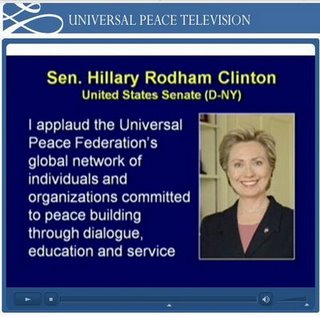
Clinton for Moon

More at my Ambassadors for Moon blog.

Moldovan President Gets Orthodox Christian Award

Russian Orthodox Patriarch Alexei II has doled out another award to a regional leader with a dodgy reputation; the Moscow Times reports:

President Vladimir Putin met with Moldovan counterpart Vladimir Voronin in the Kremlin on Tuesday to discuss trade and possibly a solution for the issue of Transdnestr.

…On Monday, Voronin, the head of Moldova’s Communist Party, received an award for “Outstanding Work to Strengthen the Unity of Orthodox Christian Peoples” from Patriarch Alexy II for resisting the expansion of the Romanian Orthodox church into Moldovan parishes.

Looks like a bit of typical quid pro quo, then. However, this Moldovan report puts a rather more seemly spiritual spin on the award:

The Patriarch of Moscow and All Russia appreciated the substantial contribution President Vladimir Voronin brought to the process of revival of the moral and spiritual values of the society, Orthodox Church, which was subject to destruction in the period of fight against the faith in God. In this respect, Aleksiy II stressed that the awarding of the prize, For Outstanding Activity to Consolidate Orthodox Nations’ Unity, to the Moldovan president speaks for itself.

[“]What we have done during all these years, and continue to do for the sake of the revival of the Orthodox Church, in the name of consolidation and development of the Moldovan citizens’ spirituality, is an unflinching factor of strengthening the stability in the society and developing the society on the whole. The unity of people and Church determines the peace and mutual understanding which dominate in our society,[“] Vladimir Voronin emphasized.

Alexei’s enthusiasm for Voronin appears to be greater than that felt by most Moldovans, according to this recent Tiraspol Times report:

According to the latest opinion poll, Putin is widely trusted by at least 66 percent of all Moldovans, or two out of three in the country. This compares to less than half that still believe in the virtue of their current leadership: In stark contrast to Putin, only 45 percent trust their own president, Vladimir Voronin. A majority of Moldova’s inhabitants have no faith that their current president is honest or trustworthy.

While Moldova is officially listed as Europe’s poorest country, its president and his close relatives rank as the richest family in the country. Their quick and unexplained road to enormous personal wealth is seen as one of the reasons why only a minority among the voters believe that Vladimir Voronin should still be worthy of their trust.

Voronin has sought to boost his popularity through such subtle means as having his face placed on the country’s stamps, alongside a bootleg EU logo (Moldova is not a member).

Another recipient of awards from Alexei is Belarus president Alexander Lukashenko; in 2002, Alexei awarded Lukashenko the Order of St. Sergius of Radonezh “for strengthening unity of Slav peoples”; the year before that, it was a prize from the “International Foundation for Unity of the Orthodox Peoples”, presumably the same award as that now presented to Voronin. As it happens, Lukashenko (commonly known as “Europe’s last dictator”) has recently been opining on the need for church and state to “unite” during the coming year, which he has decreed will be “The Year of Health”.